
 Türkçe

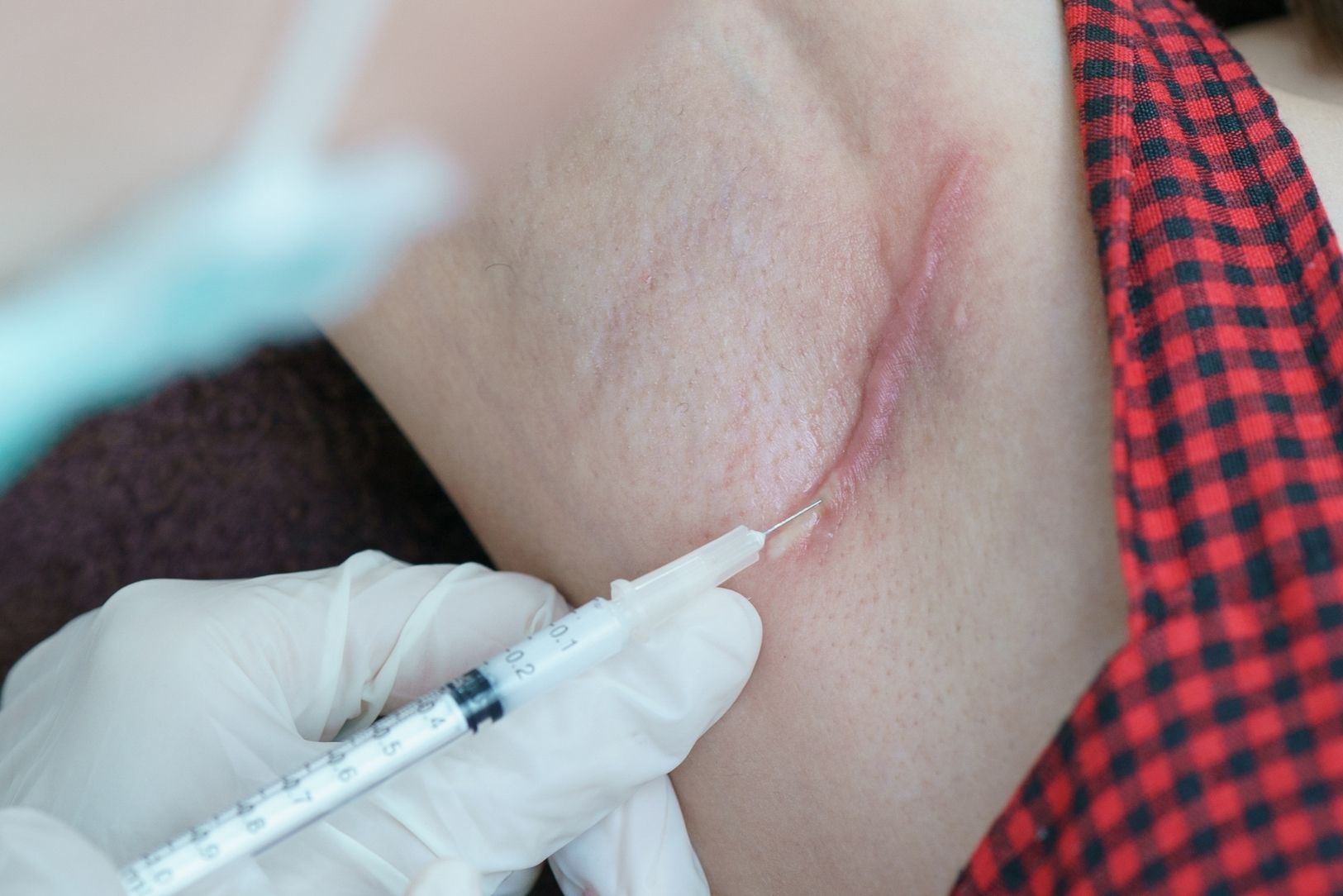
Intralesional steroid injection is a treatment method performed by applying corticosteroids directly into inflamed or thickened lesions under the skin. This method reduces inflammation, allowing the tissue to soften and the lesion to shrink. It is especially effective in conditions such as keloids, acne nodules, and lichen planus.
During the injection, a low dose of corticosteroid is administered directly into the target area with a fine-tipped needle. Thanks to this local application, systemic side effects remain minimal. The medication used is usually triamcinolone acetonide, which has a long duration of effect and controlled spread in the tissue.
The advantages of intralesional steroid injection include a rapid clinical response, reduction of inflammation, and improvement of the skin surface. The procedure is completed in a short time and generally does not require anesthesia. However, excessive dose application may cause temporary side effects such as skin thinning or hypopigmentation.
In the period after treatment, the injected area should be kept clean and protected from the sun. When necessary, optimal results are achieved with repeated sessions at intervals of a few weeks. The treatment process planned under dermatologist supervision provides long-term healing while preserving tissue integrity.
| Things You Should Know | Information |
| What is Intralesional Steroid Injection | It is a treatment method applied by injecting a corticosteroid-containing medication directly into or under the lesion with a fine needle. |
| In which conditions is it used | It is preferred in keloids, hypertrophic scars, cystic acne, psoriasis, lichen planus, lichen simplex, some nodules, cysts, and inflammatory skin diseases. |
| How is it applied | The application area is sterilized, and the corticosteroid solution is injected into the lesion with a fine-tipped needle. Local anesthesia may be applied if necessary. |
| Advantages | It provides a rapid effect because the medication is applied directly to the problematic area; it is more deeply effective than topical treatments; it has a lower risk of side effects than systemic corticosteroids. |
| Possible side effects | Side effects such as pain, bruising, thinning or depression of the skin, lightening of color, visible blood vessels, infection, and delayed healing may occur at the injection site. |
| In which conditions is it not applied | It should not be applied to infected lesions, in those who are allergic to corticosteroids, and in individuals whose general health condition is not suitable. |

Specialist Dr. Seval Karasatı
Dr. Seval Karasatı is a dermatology (skin diseases) specialist in Ankara specializing in skin health, hair and nail diseases, aesthetic dermatology, and laser applications. With her scientifically based approach and aesthetic perspective, she offers personalized treatment plans for each of her patients.
In the field of dermatology, Dr. Seval Karasatı specializes not only in common skin problems such as acne, rosacea, eczema, allergic skin diseases, and hair loss, but also in mole monitoring and the early diagnosis of skin cancers. She provides effective solutions to her patients with modern devices and up-to-date treatment methods.
Serving as a dermatology specialist in Ankara, Dr. Seval Karasatı is also experienced in aesthetic dermatology procedures. She applies holistic treatments aimed at skin renewal and rejuvenation with procedures such as fillers, PRP, mesotherapy, gold needle, and laser treatments.
Dr. Seval Karasatı conducts a comprehensive evaluation for each patient and shapes the treatment process according to personal needs. Her goal is not only to treat diseases but also to help achieve a healthy, vibrant, and aesthetically balanced skin appearance.
Create an Appointment
What Is Intralesional Steroid Injection?
Intralesional steroid injection is a treatment method applied by injecting corticosteroid medication directly into inflamed or thickened skin lesions. It is especially used in dermatological diseases such as keloids, hypertrophic scars, acne nodules, psoriasis, and lichen planus. It reduces inflammation, decreases the volume of the lesion, and relieves symptoms. The application can be performed with local anesthesia, and several sessions may generally be required.
Why is intralesional injection preferred so often?
We can think of our skin as a strong, multilayered castle wall that protects us from external factors. Many skin problems (such as cystic acne and scars) occur in the depths of this wall, in the middle or lower layers (dermis).
The creams we apply from the outside have a very hard time crossing this solid wall (the epidermis) and reaching that depth; most stay on the surface. Pills taken orally distribute the medication throughout the whole body through the blood. This both weakens the effect and causes side effects in unrelated organs.
Intralesional injection solves both of these problems. With a very fine needle, it passes through that castle wall instantly and leaves the medication exactly where the problem is, at the “scene of the incident.”
In this way, we achieve the highest strength of the medication in the exact millimetric area where it is needed. At the same time, because the medication does not spread throughout the entire body and stays only local (regional), we are also largely protected from the serious systemic side effects of oral corticosteroids.
How do these intralesional injections work in the body?
The basis of these injections lies in two important effects of cortisone.
The first is that cortisone is a very powerful “fire extinguisher” (anti-inflammatory). Inflammation is the body’s natural response to a problem; it manifests itself with redness, swelling, and pain. Cortisone cuts off the chemical signals that initiate this inflammatory reaction. By rapidly extinguishing the “fire” in the area, it reduces swelling and decreases pain. This allows the inflammation in a cystic acne lesion or an alopecia areata area to calm down quickly.
Its second and perhaps more important effect is its ability to “suppress tissue growth” (anti-fibrotic). Especially when it comes to keloids and raised scars (hypertrophic scars), the problem is that the cells we call “fibroblasts” go out of control and produce excessive amounts of collagen (the building block of the skin). This creates a hard, raised, and growing tissue.
The injected cortisone gives the command “Stop, slow down!” to these overactive fibroblasts. It prevents them from multiplying and stops them from producing new collagen. In this way, the existing scar softens over time, becomes thinner, and its raised and red appearance decreases.
In which skin problems is intralesional injection used?
This method can be life-saving in many localized and stubborn skin problems. The main conditions in which it is used are as follows:
- Keloids (abnormal, excessively growing scars)
- Hypertrophic scars (raised scars)
- Cystic and nodular acne (deep, painful, “blind” pimples)
- Alopecia Areata
- Lichen Simplex Chronicus (thickening of the skin due to constant scratching)
- Nodular Prurigo (very itchy, hard bumps)
- Discoid Lupus Erythematosus (a type of lupus affecting the skin)
- Localized psoriasis (stubborn, thick plaques)
- Granuloma Annulare (ring-shaped bumps)
- Inflamed epidermoid cysts
Does intralesional injection really work in acne treatment?
Yes, and it has a very important place; however, one point should be clarified: This is not a treatment that solves the widespread acne problem at its root. In acne treatment, this injection is an “emergency intervention” or “crisis management” tool.
It is a scenario all of us may have experienced: a few days before a very important event, wedding, or meeting, suddenly a huge, painful, red, and “blind” pimple (nodule or cyst) appears on the face or in a visible place. These acne lesions are not only very painful but also carry a very high risk of leaving a permanent depression (scar) after bursting and healing.
This is exactly where intralesional injection comes into play. Cortisone is injected at a very low and safe concentration into the exact center of that pimple. The goal is to rapidly extinguish the intense inflammatory “fire” inside that pimple.
The result is remarkably effective: generally, within 24 to 72 hours, that large, painful nodule becomes noticeably flatter, and its redness and pain decrease. This rapid intervention is very effective in preventing the pimple from growing further, bursting, and most importantly, leaving a permanent scar. To emphasize again; this is not to treat all the acne on the face, but it is a savior only for certain large and problematic “individual” lesions.
How does intralesional injection work in the treatment of alopecia areata?
Alopecia areata, in other words patchy hair loss, occurs as a result of our immune system experiencing a kind of “confusion” and perceiving our own hair follicles as “foreign” or “enemy” and attacking them. This attack causes intense inflammation around the hair follicles, and this leads to hair loss.
Intralesional steroid injection is one of the first-choice treatments especially in adults and adolescents with a limited number (a few) of hair loss areas.
The logic of the treatment is very simple: to deliver the medication, namely cortisone, exactly to the place where the battle is taking place, to that inflamed area around the hair follicles. It is very difficult for applied creams to go down to this depth.
In practice, many small injections are made into the hairless area, generally at intervals of 1 cm. In this way, the cortisone spreads exactly to where the immune system cells are attacking. It suppresses the inflammation there, tells the immune system cells to “retreat,” and gives the hair follicle the opportunity to re-enter its normal cycle and produce healthy hair again. This treatment is generally repeated monthly and has a fairly high success rate.
Why is intralesional injection so important in keloids and scars?
Keloids are not like ordinary scars. A normal wound heals and stops; a keloid, however, is an out-of-control tissue growth that continues to grow, spread, itch, and hurt even after healing is complete. This is the skin’s “over-healing” response. Hypertrophic scars, on the other hand, are raised scars that remain within the wound borders.
In both of these cases, the main problem is the continuous production of collagen by the cells we call “fibroblasts.”
Intralesional injection is one of the “gold standard” treatments for this kind of scar. Because the injected cortisone goes directly onto those overactive fibroblasts. It suppresses their proliferation and collagen production. It also reduces the reddish appearance by narrowing the vessels feeding the scar.
When applied in regular sessions, it provides a noticeable improvement in that hard, raised, and red scar. The main goals of the treatment are:
- Flattening of the raised area
- Softening of the hard tissue
- Reduction of redness
- Relief of itching
- Elimination of pain or tenderness
This treatment requires patience. A miracle should not be expected in a single session. Generally, as a result of sessions repeated at intervals of 4–8 weeks, the scar gradually shrinks and approaches the level of normal skin.
Contact Us for Anything You Wonder About Skin Health!
Is intralesional injection alone sufficient in the treatment of keloids?
Especially in large, old, and “stubborn” keloids, the power of cortisone injection alone may not be enough. Or there may remain a risk of the scar growing again (recurring) after the treatment ends.
For this reason, “combined” treatments are frequently used in dermatology in order to obtain better and more permanent results. The effect of cortisone injection increases dramatically when it is used together with another method.
The most commonly used combinations:
- Cryotherapy (freezing treatment)
- 5-Fluorouracil (5-FU) injections
- Laser treatments
- Surgical removal (especially in large keloids)
For example, the keloid tissue is first frozen with cryotherapy; this softens and damages the tissue, and the cortisone injection given immediately afterward becomes much more effective. Or cortisone may be mixed and injected with another medication called 5-FU, which stops cell proliferation. This is especially very successful in reducing the risk of recurrence. Which combination will be selected is determined by the physician according to the condition, location, and size of the scar.
Is the intralesional injection procedure painful?
This is one of the subjects patients are most curious about. The pain felt during the procedure is generally described as “a slight sting” or “a mosquito bite.” Because the needles used in this procedure are very, very fine (they may even be thinner than insulin needles).
Pain threshold varies from person to person. Of course, while medication is being given into a very hard tissue such as a keloid, some pressure and burning sensation may occur. The scalp is also a sensitive area. However, this sensation passes within seconds.
If the patient is very sensitive or if an application is to be made to a sensitive area such as the eyebrows, a topical anesthetic (numbing) cream may be applied to the area approximately 30–60 minutes before the procedure. This cream greatly reduces or completely eliminates the pain of needle entry. In other words, there is no such thing as “unbearable” pain, and there are options available to make the procedure much more comfortable.
Which medications and doses are used in intralesional injection?
The most commonly used medication in this treatment is Triamcinolone Acetonide, which is a type of cortisone. This medication is available in different strengths (concentrations), such as 10 mg mL and 40 mg/mL.
This is the most critical point of the treatment: The same dose is not applied to every problem.
The dense 40 mg mL form is used only for very thick, hard, and resistant keloids. If you take this dose and apply it to a pimple or a fine lesion on the face, there will definitely be a depression (atrophy) in that area.
For this reason, the physician adjusts this medication like a “tailor” according to the person and the problem. Most of the time, a “dilution” process is performed to bring the medication to a safe level. The concentration of the medication is reduced using sterile saline solution (salt water).
Which dose will be applied to which problem is determined according to the thickness of the skin in that area and the type of problem. As a general guide:
- Thick Keloids (e.g., shoulder, chest): High concentration 40 mg mL
- Medium-Thickness Scars: Medium concentration 10 mg mL
- Alopecia Areata (Scalp): Low-medium concentration 5-10 mg mL
- Cystic Acne (Face): Very low concentration 2.5 mg mL
- Face/Eyebrow Region Lesions: Very low concentration 2.5 mg mL
How often is the intralesional injection procedure repeated?
This is a very important safety rule. The injected cortisone acts like a “depot” in that area and is released slowly. It takes time for the medication to show its full effect and to slowly leave that area.
In addition, the body’s own cortisol balance (HPA axis) must not get used to this externally given medication. Because of this physiological waiting period, injections are generally repeated every 4 to 8 weeks (that is, once a month or once every two months).
Giving injections more frequently (for example every week) both causes excessive accumulation of the medication in that area and increases the risk of side effects (such as depression), and also invites systemic side effects due to the increased amount entering the bloodstream. For the success of the treatment, it is necessary to be patient and to comply with these session intervals.
Are there any risks or side effects of intralesional injection treatment?
Yes, like every medical intervention, this procedure also has potential side effects and risks. However, it should immediately be stated that the vast majority of these side effects depend more on the applied dose (concentration) and application technique than on the medication itself. In other words, when done at the correct dose and correct depth, these risks are minimized.
The most common possible local (regional) side effects are:
- Depression in the skin (Local atrophy)
- Lightening of the skin color (Hypopigmentation)
- Prominence of superficial capillaries (Telangiectasia)
- Small bruising or bleeding at the needle entry site
- Temporary pain or burning during the procedure
Very rarely, especially when high doses are used, temporary systemic effects may also be seen due to some of the medication entering the bloodstream.
These rare systemic effects:
- Facial flushing
- Insomnia
- Temporary elevation of blood sugar (important for diabetic patients)
- Temporary fluctuation in blood pressure
- Menstrual irregularity
Contact Us for Anything You Wonder About Skin Health!
Why does the most feared side effect, ‘skin depression’ (atrophy), occur?
This is the side effect that patients and physicians pay the most attention to. Atrophy, that is, depression or thinning of the skin, is the excessive progression of the therapeutic effect of cortisone in that area (suppression of tissue growth).
Cortisone affects not only the scar cells but also the healthy subcutaneous fat tissue and normal collagen fibers in the area where it is injected. If a higher concentration than necessary is used (for example, if a keloid dose is applied to a pimple) or if the medication is given in greater volume than necessary, cortisone “melts” the fat tissue in that area and excessively stops collagen production.
As a result, the supporting tissue beneath that area disappears and a visible “depression” or dimple-like appearance forms on the skin surface. This is most commonly seen in cystic acne treatment when safe doses such as 2.5 mg mL are exceeded. The way to prevent this risk is for the physician to choose the correct concentration and inject the medication into the correct skin layer (dermis, not fat tissue).
So, is this ‘skin depression’ permanent?
This is the most important question for patients. The good news is that this condition is TEMPORARY to a very large extent.
When the effect of cortisone gradually withdraws from that area (this takes months), the body’s natural repair mechanisms come into play again. The fibroblasts start working again, and the fat tissue partially renews itself.
However, this process is slow. It may take between 6 months and 24 months (two years) for the depression to improve on its own. Although this waiting period may be frustrating for patients, the tissue generally returns to its former state in the end.
Rarely, if a very high dose has been applied, some part of the depression may remain permanent. For this reason, with the principle of “first, do no harm,” it is essential always to start with the lowest effective dose, especially in cosmetic areas such as the face.
What is the risk of lightening of skin color (hypopigmentation) after intralesional injection?
This is another local side effect that may be seen more often especially in olive-skinned or dark-skinned patients. Cortisone also temporarily slows down the function of the cells called “melanocytes,” which produce the “melanin” pigment that gives color to the skin.
As a result, a lighter-colored patch than the surrounding normal skin forms in the injected area.
Just like skin depression (atrophy), this condition is also mostly temporary. As the effect of cortisone wears off, the melanocytes return to their normal function and the color of the area gradually returns to normal over the months. To reduce this risk, lower concentrations are preferred especially in dark-skinned patients and in visible areas such as the face.
Who should be more careful with intralesional injection treatment?
Although this treatment can be applied safely to almost everyone, in some situations it is either absolutely not done or much greater caution is required.
The situations in which the treatment is definitely not done are as follows:
Known allergy to the medication itself (Triamcinolone) or to the substances in its content
An active infection (bacterial, fungal, or cold sore/herpes) in the area where the injection will be made
Administering a cortisone injection while there is an active infection in the area may cause that infection to spread very rapidly and dangerously by suppressing the inflammation (“adding fuel to the fire”).
In addition, greater care should be taken in some systemic diseases:
- Patients with uncontrolled diabetes
- Patients with uncontrolled high blood pressure
- Immunosuppressed patients
- Those with an active stomach ulcer
It should not be forgotten that even a local injection can temporarily raise blood sugar. For this reason, it is very important for the physician to have full knowledge of the patient’s general health condition.
Frequently Asked Questions
In which skin diseases is intralesional steroid injection applied?
This treatment is applied in inflamed or thickened lesions such as keloids, hypertrophic scars, psoriasis, lichen planus, and nodular acne. The steroid suppresses local inflammation and accelerates tissue healing.
How does intralesional steroid injection work?
The injected corticosteroid is administered directly into the lesion, reducing inflammation, slowing cell proliferation, and preventing tissue thickening. In this way, raised or hard skin lesions gradually soften and shrink.
Does intralesional steroid injection have a permanent effect?
Its effect is generally long-lasting, but repeated sessions may be required depending on the type of lesion. In resistant conditions such as keloids, permanence can be increased by repeating injections at intervals of several months.
What should be considered after intralesional steroid injection?
After the procedure, it is recommended to keep the area clean and not apply makeup or cream for 24 hours. Protection from the sun is also important because steroids may cause skin thinning.
Is intralesional steroid injection a painful procedure?
Since it is applied with a needle, there may be a slight stinging sensation, but it is generally at a tolerable level. If necessary, comfort can be increased by using a local anesthetic cream.
Can intralesional steroid injection be applied during pregnancy?
It is generally avoided during pregnancy because there is a risk of systemic passage of steroids even if applied locally. However, in very necessary situations, it can be applied under doctor supervision and at low doses.
What are the side effects of intralesional steroid injection?
Temporary thinning of the skin, color change, or mild depression may occur. These effects are usually temporary and can be controlled by reducing the injection dose.
How long does it take for the skin to heal after intralesional steroid injection?
Noticeable improvement generally begins within 2–4 weeks. However, depending on the structure of the treated lesion, the full result is achieved after several sessions.
Does a keloid disappear completely with intralesional steroid injection?
Keloids generally do not disappear completely, but they become significantly flatter and their redness decreases thanks to the injection. Treatment applied at appropriate doses and intervals may provide permanent results.
Will a mark remain after intralesional steroid injection?
Rarely, temporary whitening or skin thinning may be seen in the injection area. This condition generally improves within a few months and the skin tone returns to normal. With a good technique, this risk is minimal.