
 Türkçe

Age spot treatment is a dermatological application aimed at eliminating hyperpigmentation that develops on the skin as a result of sun exposure, aging, and melanin accumulation. These spots are generally seen on the face, hands, and décolleté area; with treatment, skin tone is balanced and the appearance of the spots is reduced.
Laser treatment is one of the most effective methods for removing age spots. Q-switched and fractional laser systems target melanin pigment and renew the skin surface. This method breaks down pigmented cells with controlled heat energy and provides a more homogeneous skin appearance.
Chemical peeling and microdermabrasion applications are used in the treatment of superficial pigmentations. Solutions containing alpha hydroxy acid (AHA) and trichloroacetic acid (TCA) support new cell formation by exfoliating the upper layer of the skin. Regular sessions reduce the persistence of the spots.
Topical creams and medical skincare products support the treatment process. Formulations containing retinoids, vitamin C, and hydroquinone suppress melanin production. The use of sunscreen in the skincare routine is the most important step in preventing new spot formation.
| What You Need to Know | Information |
| What is an age spot? | Age spots (solar lentigines) are flat brown or almost black spots on the skin that develop as a result of the aging process and long-term sun exposure. They are usually seen on sun-exposed areas such as the face, hands, shoulders, and décolleté. |
| Formation mechanism | Long-term exposure of the skin to UV rays causes an increase in melanin production. This increases the activity of melanocyte cells, leading to pigment accumulation in certain areas and the formation of age spots. |
| Harmless or risky? | Age spots are generally harmless. However, if changes are seen in the shape, color, size, or borders of the spot, a dermatological evaluation should be performed considering the possibility of a malignant skin disease. |
| Treatment methods | • Laser treatment: Targets melanin and breaks down the pigment.• Chemical peeling: Supports new skin formation by exfoliating the skin with substances such as AHA and TCA.• Microdermabrasion: Physically renews the skin surface.• Topical creams: Provide a spot-lightening effect with ingredients such as retinoids, vitamin C, hydroquinone, and azelaic acid. |
| Things to consider before / after | Before treatment, it should be confirmed that the spot is harmless, and dermoscopic examination should be performed if necessary. A personalized treatment plan should be created by taking skin type and sun exposure history into account. Sun protection is important after treatment; broad-spectrum sunscreens, hats, and protective clothing should be used. |

Specialist Dr. Seval Karasatı
Dr. Seval Karasatı is a dermatology (skin diseases) specialist in Ankara specializing in skin health, hair and nail diseases, aesthetic dermatology, and laser applications. With her scientifically based approach and aesthetic perspective, she offers personalized treatment plans for each of her patients.
In the field of dermatology, Dr. Seval Karasatı specializes not only in common skin problems such as acne, rosacea, eczema, allergic skin diseases, and hair loss, but also in mole monitoring and the early diagnosis of skin cancers. She provides effective solutions to her patients with modern devices and up-to-date treatment methods.
Serving as a dermatology specialist in Ankara, Dr. Seval Karasatı is also experienced in aesthetic dermatology procedures. She applies holistic treatments aimed at skin renewal and rejuvenation with procedures such as fillers, PRP, mesotherapy, gold needle, and laser treatments.
Dr. Seval Karasatı conducts a comprehensive evaluation for each patient and shapes the treatment process according to personal needs. Her goal is not only to treat diseases but also to help achieve a healthy, vibrant, and aesthetically balanced skin appearance.
Create an Appointment
What Is an Age Spot?
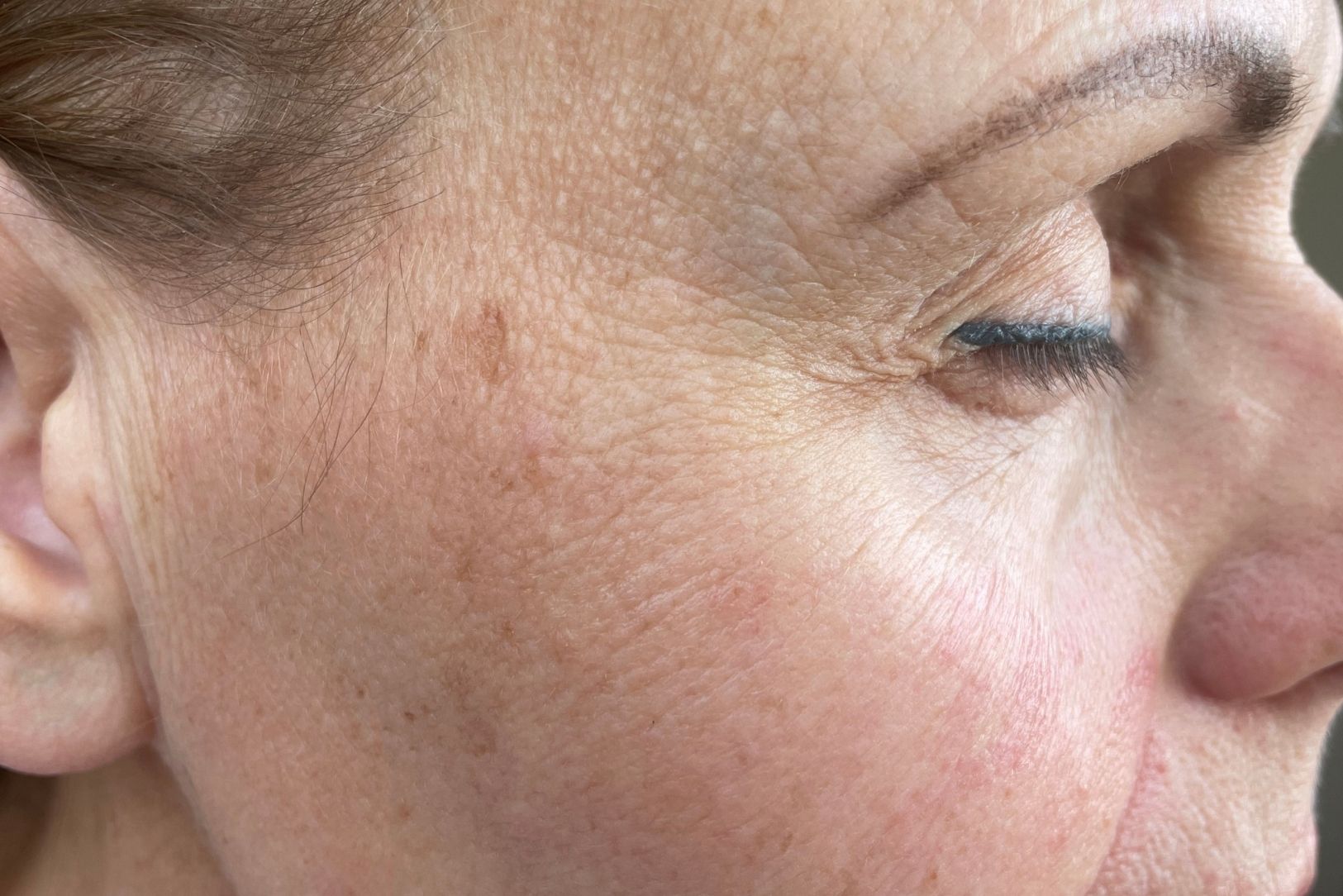
Age spots are flat brown or black pigment accumulations on the skin that usually appear at older ages as a result of long-term sun exposure. They are most commonly seen on sun-exposed areas such as the face, hands, shoulders, and arms. Medically called solar lentigines, these spots are harmless but can be treated for cosmetic concerns. Their appearance can be reduced with laser, chemical peeling, and topical creams.
Why do age spots form?
These spots are usually seen as flat, oval or irregularly shaped lesions with shades ranging from light brown to dark brown. The condition they are most often confused with is freckles (ephelides). The most basic difference between them is this: freckles are largely genetic and tend to fade during winter or in the absence of sun. Age spots (solar lentigines), on the other hand, are specifically triggered by sun damage, indicate a permanent change in the skin structure, and do not disappear even when there is no sun.
The number one cause of these spots is UV radiation coming from both natural sunlight and artificial sources such as tanning beds. They are especially common in fair-skinned individuals who burn easily in the sun but tan poorly (Fitzpatrick Skin Types I-III). However, this does not mean that darker-skinned people are safe; spot formation is directly related not so much to skin color as to the total lifetime sun exposure and especially intense sunburns experienced at a young age.
How do these spots become permanent inside the skin?
Understanding this explains why treatment requires more than a simple cream. Normally, the cells called “melanocytes” that give our skin its color are distributed relatively evenly in the upper layer of the skin (the epidermis). However, chronic UV damage causes these cells to cluster together in certain areas, accumulate, and increase in number.
In this damaged area, at the boundary where the upper (epidermis) and lower (dermis) layers of the skin meet, these pigment cells increase both in number and in activity; in other words, they begin producing much more pigment (melanin) than normal. This is why the spot becomes permanent: it is not just a “pool” of color, but also a permanent increase in the number of pigment cells in the skin structure. Therefore, an effective treatment must either destroy the cells in this area by targeting them (such as with laser) or suppress these cells’ pigment production over the long term (with special creams).
Is every sun spot harmless, and why is it essential to see a doctor?
This is perhaps the most critical question in the whole process. Age spots (solar lentigines) are benign by nature. However, their clinical appearance (being flat, brown, and sometimes irregularly bordered) can be dangerously similar to “Lentigo Maligna” (LM) or “Lentigo Maligna Melanoma” (LMM), an early form of melanoma, which is one of the most dangerous types of skin cancer.
What you think is an “age spot” may actually be a slowly growing skin cancer. Before starting any cosmetic treatment (especially procedures such as laser, cryotherapy, or peeling that will remove the spot), it is “mandatory” for a dermatology specialist to make sure that the spot is definitely benign.
Warning signs that a spot may be dangerous include:
- Rapid growth
- Becoming asymmetric in shape
- Irregular borders (indented or uneven edges)
- Change in color (darkening, becoming black, or appearing mottled)
- Bleeding on the surface
- Itching or tenderness
- New appearance (especially at an older age)
If any of these changes are noticed, a dermatologist should be consulted immediately.
Which method does your doctor use to determine the type of your spot?
The most valuable tool used to determine whether a pigmented (colored) lesion is benign or potentially malignant is “Dermoscopy.” A dermoscope is a special handheld device with a strong light source and magnifying lenses at its tip.
This device allows us to see not only the surface of the skin but also the layers just beneath the surface. It gives us critical clues about the distribution of pigment, vascular structures, and the internal architecture of the lesion that cannot be seen with the naked eye.
The facial area in particular requires dermoscopic criteria different from those of other parts of the body because of its anatomical structure. Under dermoscopy, an expert eye can distinguish the features of a benign sun spot (for example structures such as “pseudofollicular openings”) from the dangerous features of a malignant lentigo maligna (for example “asymmetrically pigmented follicular openings”). This evaluation is the first and most important step for proceeding safely with cosmetic treatment.
What does my skin type have to do with spot treatment?
Your skin type, especially your skin color, plays a “fundamental” role in treatment planning. In dermatology, the Fitzpatrick Skin Phototype (FST) is used to classify how the skin responds to the sun. This determines your skin’s tendency to burn and tan in the sun.
The main categories of this classification are:
- FST I-II: Very fair skin, light-colored eyes, burns easily, hardly ever tans.
- FST III-IV: Wheatish or olive skin, sometimes burns, generally tans well.
- FST V-VI: Dark brown or black skin, rarely burns, tans very easily.
Although sun spots are more common in FST I-II, individuals with FST III-VI (that is, from wheatish to dark skin tones) are considered much more “high risk” in terms of spot treatment. The reason for this lies in the next section.
What does the risk of post-treatment pigmentation (PIH) mean?
PIH is the abbreviation for “Post-Inflammatory Hyperpigmentation.” Medically, this means the skin responds to trauma or inflammation by producing “more” pigment in that area.
More simply, you undergo a procedure (laser, peeling, freezing) to “lighten” or “erase” an existing spot, but your skin responds to that procedure (thermal damage or chemical trauma) by producing a darker, more stubborn new spot as a defensive reaction. You can think of this like the brown marks left after a pimple or wound heals.
The pigment cells (melanocytes) of people with Fitzpatrick Skin Types III, IV, V, and VI (wheatish, olive, and dark skin) are already more active and much more prone to overreacting to any stimulus by developing PIH. Therefore, spot treatment in these skin types must be planned much more carefully, at lower doses, and must include “pre-treatment preparation” protocols.
Contact Us for Anything You Wonder About Skin Health!
What should I do to prevent new spots from forming and protect the existing results?
There is only one way to maintain the success of spot treatment and prevent new spots from forming: effective, continuous, and lifelong strict sun protection. This is the “non-negotiable” rule of spot treatment.
Remember, spot treatment (laser, IPL) temporarily makes your skin even more sensitive to UV rays. Remaining unprotected causes the spots to come back even stronger than before.
An effective sun protection protocol should include the following:
- A broad-spectrum sunscreen (protecting against both UVA and UVB)
- At least SPF 30 (ideally SPF 35+ or 50+)
- Use 365 days a year, not only in summer (even on cloudy days)
- Staying in the shade whenever possible between 10:00 and 14:00, when the sun is strongest
- Wide-brimmed hats
- Protective clothing (long sleeves, lightweight fabrics)
- Being aware of reflections (snow, water, and sand reflect UV rays)
Which creams and topical agents are used in spot treatment?
Topical (skin-applied) treatments are one of the cornerstones of spot management. These agents are used for two main purposes: as the main treatment alone in mild spots, or more often as an adjunct before physical treatments such as laser/IPL for “preparation,” and after procedures for “maintenance/suppression.”
The main topical agents proven to be effective in spot treatment are:
- Hydroquinone (HQ)
- Azelaic Acid
- Mecinol / Tretinoin (vitamin A derivative) combination
- Retinoids (Tretinoin, Retinol)
- Vitamin C (L-Ascorbic Acid)
- Kojic Acid
- Niacinamide
These agents work through different mechanisms. Hydroquinone (usually in 2–4% concentration) works by blocking “tyrosinase,” a key enzyme in melanin production, which makes it one of the strongest spot-lightening agents. Azelaic acid (15–20%) is especially effective by targeting “hyperactive” pigment cells and is also very helpful in reducing the risk of PIH. The mecinol/tretinoin combination offers both an effective spot-lightening effect (mecinol) and a skin-renewing, penetration-enhancing effect (tretinoin). The choice of these agents and their duration of use must always be under dermatological supervision.
Why should spot creams also be used before laser treatment?
This is one of the most critical safety steps in treatment. Procedures such as laser, IPL, or chemical peeling apply controlled “trauma” or “heat” to the skin. The skin’s pigment cells (melanocytes) may perceive this heat and trauma as a “threat” and increase their defense mechanism (that is, pigment production) to protect the skin. This creates a PIH risk, especially in dark-skinned (FST III+) patients.
Starting “suppressive” creams such as hydroquinone or mecinol/tretinoin 2 to 6 weeks before laser or IPL treatment (depending on the skin type) “calms” or “puts to sleep” these pigment cells before the procedure. This prevents the skin from overreacting to the heat of the laser. This pretreatment increases the safety of the procedure, minimizes the risk of PIH, and significantly improves the success of the treatment.
Why is freezing treatment (cryotherapy) no longer the first choice for sun spots?
Cryotherapy (freezing the spot using liquid nitrogen) was historically a very common method for sun spots. It is quick, inexpensive, and easy to perform. However, in modern dermatology it is no longer accepted as a “first-line” treatment for cosmetic sun spots.
The most important reason for this is the risk of serious side effects. Cryotherapy can be very aggressive toward pigment cells and is not “selective”; that is, it may destroy not only the spot but also the normal pigment around it.
Its most feared side effect is “permanent hypopigmentation.” This means the area where the spot was becomes completely “white” and leaves a permanent mark lighter than the surrounding normal skin. Treating this white patch is much more difficult than treating a brown spot. In addition, if the freezing is applied too aggressively, it also has the potential to cause superficial scarring. Compared with modern laser systems, its success rates are also lower.
What role does chemical peeling play in age spot treatment?
Chemical peeling (chemoexfoliation) is an effective method for treating both age spots and accompanying signs of general skin aging (fine lines, dullness). Since age spots are a superficial problem in the uppermost (epidermal) layer of the skin, they respond well primarily to superficial or medium-depth peels.
The types of peels used in spot treatment are:
- Superficial Peels
- Medium-Depth Peels
Superficial peels (for example Alpha-Hydroxy Acids or Beta-Hydroxy Acids such as glycolic acid and salicylic acid) gently exfoliate the uppermost layer of the skin. They generally require very little downtime or none at all. They may require multiple sessions and are effective in improving overall skin tone.
Medium-depth peels (for example Trichloroacetic Acid – TCA or Jessner solution) are used when there are more resistant spots or accompanying more pronounced issues. They penetrate deeper and usually require a crusting and peeling period lasting 6–9 days. These peels must be applied with great caution, especially in dark-skinned patients with a high PIH risk.
Contact Us for Anything You Wonder About Skin Health!
Which methods are considered the ‘gold standard’ in sun spot treatment?
Today, the methods regarded as the “gold standard” in the treatment of sun spots are light and laser systems that offer high effectiveness and a superior safety profile. Unlike cryotherapy, these technologies work on the principle of “selective photothermolysis.”
This complex term actually describes a very smart mechanism: the light energy produced by these devices is “intelligent.” When applied to the skin, it “sees” only the target (that is, the excessive dark pigment in the spot), is absorbed by it, and instantly “breaks down” that pigment through heat, without damaging the surrounding normal, healthy skin tissue. This selectivity minimizes the risk of side effects (especially the risk of white spots or scars).
The gold standard technologies in this category are:
- Picosecond Lasers (Pico-laser)
- Q-Switched Lasers (Nd:YAG, Ruby, Alexandrite)
- Intense Pulsed Light (IPL / BBL)
Picosecond (one trillionth of a second) and Q-switched nanosecond (one billionth of a second) lasers break the pigment mechanically with a shockwave effect (through a very short pulse duration), whereas IPL targets it more through heat (with a longer pulse duration). The choice is made according to the type and depth of the spot and the patient’s skin type.
How does IPL (Intense Pulsed Light) affect spots?
IPL (Intense Pulsed Light) is not a laser, but it is a powerful broad-spectrum light technology that can be as effective as lasers in spot treatment (also known as BBL – BroadBand Light). The greatest advantage of IPL is its “versatility.”
While lasers usually use a single wavelength, IPL devices send a selected beam of light to the skin through different “filters.” For example, when a specific filter such as 515-nm is used, the light energy primarily targets the melanin in brown spots and the hemoglobin in facial redness.
This makes IPL an excellent option not only for sun spots but also for overall “photorejuvenation” of the face.
The advantages of IPL treatment are:
- It clears sun spots
- It reduces capillaries and facial redness (rosacea)
- It evens out skin tone
- It tightens enlarged pores
- It improves overall skin quality by stimulating collagen production
It generally requires minimal downtime after the procedure. The spots temporarily darken and then shed like “coffee grounds” within a few days.
Why should age spot treatments be combined for the best results?
In dermatology, especially in stubborn spot cases, “combination therapy” often provides far better results than a single method alone. The best result comes from an intelligently designed protocol that targets different layers of the skin and different components of the spot.
An ideal spot treatment algorithm generally includes the following steps:
- Preparation Phase (2–6 Weeks): Topical suppressive creams (for example Hydroquinone or Mecinol/Tretinoin) are used to prepare the skin for laser/IPL, “calm” the pigment cells, and reduce the risk of PIH.
- Procedure Phase (Treatment Day): Once the skin is prepared, the pigment in the spot is physically “broken down” with laser or IPL.
- Healing and Protection Phase (After the Procedure): Once the skin has healed (about 1 week later), suppressive creams may be continued for a while to prevent the pigment cells from being reactivated, and lifelong sun protection begins.
This multi-step approach both ensures rapid clearing of the spot and maximizes the safety of the treatment and the permanence of the result.
What should be considered during the healing period after laser or IPL?
Post-procedure care is at least as important as the procedure itself for the success of the treatment. After the procedure, mild redness, swelling, and temporary darkening or crusting of the spots are expected normal processes.
Things that should be ‘done’ during the healing period include:
- Using the repairing creams recommended by your dermatologist
- Washing the skin with gentle, fragrance-free, soap-free cleansers
- Keeping the skin constantly moisturized with non-comedogenic moisturizers
- Being extremely careful about sun protection (SPF 50+ and a hat)
- Things that should ‘not’ be done during the healing period.
- Never picking, pulling off, or scratching the crusts that form (this causes scars or new spots)
- Not scrubbing the skin with exfoliants or rough towels
- Avoiding hot water, Turkish baths, or saunas for the first few days
Not using any other cosmetic products (acidic toners, retinol, etc.) without your doctor’s approval
Frequently Asked Questions
Why do age spots develop and which factors increase the risk?
Age spots develop as a result of long-term sun exposure, aging, and genetic predisposition. The risk is higher in fair-skinned people, those who do not use sunscreen, and smokers.
What are effective medical treatment methods for age spots?
Laser treatment, plasma energy, chemical peeling, cryotherapy, and medical creams are commonly used in the treatment of age spots. These methods reduce the intensity of pigment in the skin and lighten the color of the spots.
Does laser treatment for age spots provide permanent results?
Spots can be removed to a large extent with laser treatment, but sun protection is essential to prevent new ones from forming. Regular care after treatment increases permanence.
How does chemical peeling work on age spots?
Chemical peeling exfoliates the dead layer of the skin and reduces melanin density. This process supports skin renewal and gradually lightens the appearance of spots.
Do natural home remedies work for age spots?
Products containing lemon, aloe vera, or vitamin C may brighten the skin, but they do not replace professional treatments. Incorrect applications may cause skin irritation.
How can age spots be prevented through sun protection?
Daily use of broad-spectrum sunscreens, wearing a hat, and avoiding going outdoors during peak sun hours significantly reduce the formation of spots.
How can age spots be distinguished from skin cancer spots?
Age spots are usually flat, light brown, and symmetrical. If a spot grows rapidly, changes shape, or bleeds, it must be evaluated by a dermatologist.
Do age spots recur after treatment?
Yes, if sun protection is neglected, new spots may appear. Adding regular sunscreen to the skincare routine and keeping the skin moisturized reduces the risk of recurrence.
Which skin types are more prone to age spots?
Fair, delicate, and sun-sensitive skin types are more prone to age spots. In addition, hormonal changes during menopause may also increase the risk.
What skin care is recommended after age spot treatment?
After treatment, the skin should be cleansed gently, moisturized, and protected with a high-factor sunscreen. Irritating peels should be avoided for a period of time.