
 Türkçe

The Demodex test is a microscopic examination performed to determine the presence and density of Demodex mites, which naturally exist on the skin but can cause dermatological problems when they multiply excessively. This test is generally performed on patients who have complaints such as recurrent redness, itching, and scaling on the face.
In performing the test, a skin scraping or eyelash sample taken onto a special slide is used. The sample is examined under a microscope to determine the number and type of mites. Thus, the density of species such as Demodex folliculorum or Demodex brevis is determined and an appropriate treatment plan is created.
The Demodex test is of great importance in the differential diagnosis of diseases such as rosacea, chronic acne, and seborrheic dermatitis. In cases where the mite density is high, the treatment plan is supported with topical mite-killing agents, medical cleansing products, and hygiene measures.
Before the test, not cleaning the skin and not using cream or makeup products are necessary for the accuracy of the results. The procedure is painless and is completed within a few minutes. Early diagnosis ensures that the mite population is brought under control and skin health is preserved.
| Things You Should Know | Information |
| What is the purpose of the Demodex test | It is performed to detect the presence and density of Demodex mites located on the skin or at the roots of the eyelashes. |
| How is the test performed | A skin scraping or eyelash sample is taken from the face area and the presence and number of mites are evaluated under a microscope. |
| In which cases is it recommended | It is recommended in cases such as long-standing facial redness, itching, scaling, acne-like lesions, eyelid inflammations, and treatment-resistant rosacea. |
| What is done if the test is “positive” | If the mite density is high, topical mite-killing treatments, medical skin cleansing, and appropriate hygiene measures are applied. |
| Things to consider before the test | Before the test, makeup, cream, or moisturizer should not be applied to the skin; the face should be left clean and in its natural state. |

Specialist Dr. Seval Karasatı
Dr. Seval Karasatı is a dermatology (skin diseases) specialist in Ankara specializing in skin health, hair and nail diseases, aesthetic dermatology, and laser applications. With her scientifically based approach and aesthetic perspective, she offers personalized treatment plans for each of her patients.
In the field of dermatology, Dr. Seval Karasatı specializes not only in common skin problems such as acne, rosacea, eczema, allergic skin diseases, and hair loss, but also in mole monitoring and the early diagnosis of skin cancers. She provides effective solutions to her patients with modern devices and up-to-date treatment methods.
Serving as a dermatology specialist in Ankara, Dr. Seval Karasatı is also experienced in aesthetic dermatology procedures. She applies holistic treatments aimed at skin renewal and rejuvenation with procedures such as fillers, PRP, mesotherapy, gold needle, and laser treatments.
Dr. Seval Karasatı conducts a comprehensive evaluation for each patient and shapes the treatment process according to personal needs. Her goal is not only to treat diseases but also to help achieve a healthy, vibrant, and aesthetically balanced skin appearance.
Create an Appointment
What is Demodex and why does it become a problem on our skin?
Demodex is actually a microscopic, eight-legged tiny creature that lives on all of our skin, in our hair follicles, and inside the sebaceous glands connected to these follicles. This parasite, which is a type of “mite,” has two species that are most commonly seen in humans. While the first one (Demodex folliculorum) prefers to live more on the surface of hair follicles, the second one (Demodex brevis) settles deeper, right inside the sebaceous glands.
These creatures are normally natural inhabitants of our skin. They feed on the skin oil (sebum) we produce and dead skin cells. In healthy skin, their numbers are always kept under control thanks to our immune system and the natural balance of our skin. In this state, they live silently with us without causing any complaints or symptoms.
The problem begins when this balance is disrupted. If there is a weakening in the local immune system of the skin, if the skin barrier is damaged, or if oil production in the skin increases excessively, a perfect breeding environment is created for Demodex mites. They begin to multiply rapidly in an uncontrolled manner. This condition of excessive proliferation is called “demodicosis” in medical terms.
So what happens when their numbers increase that starts to bother us? There are several reasons for this.
First, when their numbers increase too much, they can physically block the hair follicles and the ducts of the sebaceous glands. Second, these creatures themselves or the fragmented remains of their bodies when they die stimulate our skin’s immune system. The skin reacts to this situation as a “danger,” and inflammation begins. This inflammation manifests itself as redness, burning, stinging, itching, and inflamed acne-like bumps (pustules). In addition, these mites can carry certain bacteria on their surface, and these bacteria can also cause the inflammation to intensify.
For this reason, Demodex density can be both the trigger and the main cause of chronic skin problems such as especially “rosacea” and stubborn “eyelash root inflammation” (Blepharitis) that do not respond to treatment.
What Is the Demodex Test?
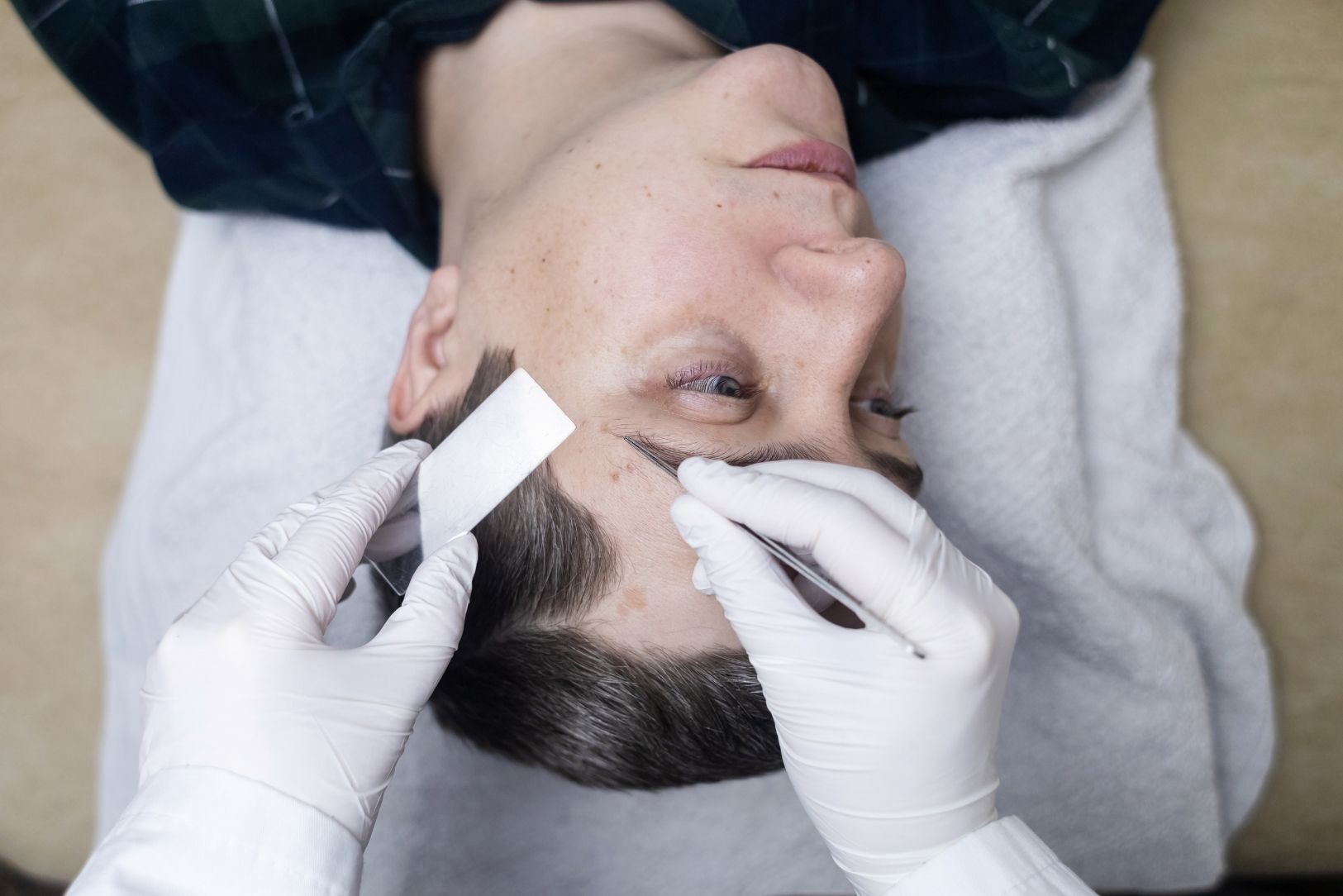
The Demodex test is a dermatological examination performed to detect the presence of microscopic mites called Demodex living on the skin or at the roots of the eyelashes. It is especially applied in people who have complaints such as itching, redness, acne-like lesions on the face area, and irritation around the eyes. For microscopic examination, a skin scraping or eyelash sample is taken and the number and presence of mites are evaluated. Treatment is planned according to the mite density.
Which complaints require having a Demodex test?
It is not necessary to perform a Demodex test immediately on every person with facial redness or acne. However, some stubborn and treatment-resistant conditions directly require suspicion of Demodex density. The main ones of these conditions are:
- Treatment-resistant rosacea
- Acne-like inflamed bumps on the face (papules and pustules)
- Persistent widespread facial redness and skin sensitivity
- Prominence of hair follicles and a rough appearance like “sandpaper”
- Fine, sticky dandruff on the face and scalp
- Stubborn eyelid inflammation (Blepharitis)
- A constant feeling of itching, burning, stinging, or dryness in the eyes
- Deposits at the roots of the eyelashes (especially cylindrical dandruff)
- Eyelash loss (madarosis)
- Frequently recurring styes (chalazion)
- Itching and redness that remain unresponsive to standard treatments (antibiotic creams, etc.)
If you have such complaints and cannot get results from the treatments applied, a test is essential to understand whether the underlying cause is Demodex density.
What does it mean to test “positive” in the Demodex test?
This is the subject that these patients worry about most and misunderstand. If your test result says “Demodex was seen” or “positive,” it absolutely does not mean that you are ill or that you need to start treatment immediately.
It is useful to remind again: Demodex is a normal inhabitant of our skin. Especially in adults, the rate of presence is very high, and as age advances this rate approaches 100%. In other words, seeing one or two Demodex on your skin is a completely normal and expected condition.
In dermatology, what is important for us is not the “presence” of the parasite but its “density.”
There is a clear internationally accepted threshold value for the diagnosis of disease (demodicosis). This threshold is the number of mites per square centimeter.
Threshold Value: 5 or more mites per square centimeter
If, as a result of the test performed, fewer than 5 mites (for example 1, 2, or 3) are counted in the examined 1 cm2 skin area, this situation is accepted as “normal” and is generally not seen as the main cause of your current complaints.
However, if the density reaches 5 mites cm2 and above in the count performed, then this situation is called “pathogenic overgrowth.” This result shows that this density is most likely responsible for the inflammation and complaints on the skin. The treatment decision is also made according to this numerical result. In short, in the diagnosis of Demodex, the “number” is more important than anything else.
How is the “Gold Standard Test” (SSSB) for Demodex density on the face performed?
The “gold standard” diagnostic method we use to objectively and reliably count the density of Demodex on the face per square centimeter is called Standard Superficial Skin Biopsy (SSSB).
Do not let the fact that its name contains “biopsy” scare you. In this procedure, absolutely no surgical incision, stitch, needle, or anesthesia is used. In fact, it is a completely painless and simple tape test performed with cyanoacrylate, which is a special medical and sterile form of the substance popularly known as “Japanese glue.” It is the most preferred test especially in suspicion of rosacea to clearly determine that critical threshold of 5 mites cm2.
The application steps of this test are as follows:
- Preparation: First, a standard microscope slide to be examined is taken and a square of exactly 1 cm2 is drawn on it.
- Adhesive: A drop of cyanoacrylate adhesive is dropped onto the surface of the glass that will come into contact with the skin, exactly over this marked area.
- Application: Without waiting at all, this adhesive glass is pressed firmly onto the area where the complaint is most intense (usually the cheek, chin, or bridge of the nose).
- Waiting: The glass is held fixed on the skin for approximately 1 minute so that the adhesive dries and adheres to the uppermost layer of the skin. During this time, a very slight, temporary burning or warming sensation may be felt due to the drying of the adhesive; this is normal.
- Sampling: When one minute has passed, the glass slide is gently but firmly pulled away from the skin.
- Result: With this pulling process, the uppermost dead layer of the skin (stratum corneum) and the material accumulated at the entrances of the hair follicles in that area (sebum, keratin, and the Demodex mites living there) are transferred together with the adhesive onto the surface of the glass.
- Examination: A special oil is dropped onto this sample to clarify the image under the microscope and it is covered.
- Counting: The sample is immediately examined under the microscope and all Demodex mites (adults, larvae, and eggs) in that 1 cm2 area are counted one by one.
The result is reported as X mites cm2 and the treatment decision is made according to this number. This method is the most reliable one in determining density numerically.
Contact Us for Anything You Wonder About Skin Health!
Can there be a deficiency or error in the SSSB (adhesive test) method?
Yes, although SSSB (the adhesive test) is the gold standard for detecting density, it is not perfect and can be misleading in some situations. Knowing this limitation is very important in order to interpret the test result correctly.
The most important limitation of this method is related to the places where the two different Demodex species we mentioned at the beginning of the article live:
- Demodex folliculorum (Superficial): Lives at the entrance of the hair follicle, close to the surface.
- Demodex brevis (Deep): Lives inside the sebaceous glands, that is, deeper.
The SSSB (adhesive) method samples the uppermost layer of the skin and the entrances of the hair follicles. Therefore, it is very successful in capturing D. folliculorum living on the surface.
However, if the patient’s problem is caused by D. brevis living deeper, the cyanoacrylate adhesive may not always reach that deep (that is, into the sebaceous gland). In this case, even if there is an intense D. brevis population deep in the skin, the SSSB test may fail to capture these mites and the result may come out as “negative” or “low density” (for example 1-2 mites cm2). This is called a “false negative.”
If a patient’s complaints (for example, hard, inflamed bumps coming from deep) strongly suggest Demodex, but the SSSB test is negative, it must definitely be kept in mind that this may be due to the deep D. brevis not being captured. In such a case, it may be necessary to resort to an alternative method such as “Skin Scraping” to confirm the diagnosis.
What is “Skin Scraping” (DME), a rapid Demodex test?
“Skin Scraping,” or by its medical name “Direct Microscopic Examination” (DME), is another faster and more practical method used to detect Demodex. Compared to the SSSB (adhesive) method, it has advantages and disadvantages:
In this test, unlike the adhesive method, the aim is to collect a sample by physically scraping the surface of the skin.
The steps of this test are as follows:
- Equipment: For this procedure, a laboratory spatula or a sharpened-tip-free (blunted) scalpel (surgical blade) is generally used. The purpose here is never to cut the skin, but only to scrape its surface.
- Lubrication: A generous amount of mineral oil (or microscope oil) is applied both to the suspicious area of the skin (usually a 1 cm2 area) and to the tip of the scraper (scalpel or spatula). This oil both facilitates the scraping procedure and allows the collected material to adhere to the scraper.
- Scraping: With the lubricated scraper, the target area is scraped firmly until the skin becomes slightly red and irritated (a superficial abrasion is targeted). This procedure generally does not lead to bleeding.
- Examination: The mixture of oil, debris, and hair follicle contents accumulated on the tip of the scraper is transferred onto a glass slide onto which one more drop of oil has been dropped.
- Result: It is covered with a coverslip (thin cover glass) and immediately examined under the microscope, and the Demodex are counted.
This method is much faster than SSSB (it takes about 30 seconds) and there is no waiting period as in the adhesive procedure.
Which Demodex test is better: Scraping (DME) or Adhesive (SSSB)?
There is no clear answer to this question, because both tests have strengths and weaknesses relative to each other. Which test is chosen varies depending on the patient’s complaints and what the doctor is targeting.
- SSSB (Adhesive) Method:
This method is much superior in determining density numerically (quantification). Studies have shown that SSSB captures far more mites than the scraping method (sometimes up to 10 times more). If there is an inflammatory condition concentrated in a particular area such as rosacea and what is important for us is to confirm the exact numerical threshold of 5 mites cm2, this is the “gold standard” method that should be preferred.
- DME (Scraping) Method:
This method is very fast and more practical to apply. However, its biggest disadvantage is that it generally shows the real density as “lower than it actually is.” In other words, if 2 mites cm2 are found with this test, the real density might perhaps be 10 mites cm2 if examined with SSSB.
However, there is an interesting situation in which the scraping method is superior to SSSB: if the suspicion of Demodex is in the form of widespread redness, sensitivity, and fine scaling (pityriasis folliculorum) over the general face, the scraping test may give better results. Because the scraping procedure is more successful at collecting superficial samples from a wide area.
In short, SSSB (Adhesive) may be preferred for a definite numerical result, and DME (Scraping) may be preferred for rapid screening or widespread conditions. Both tests are valuable and valid in dermatology practice.
Contact Us for Anything You Wonder About Skin Health!
How is the test performed for Demodex on the eyes and at the roots of the eyelashes?
When we suspect eye and eyelash root involvement (Demodex blepharitis), our approach is a little different from the tests on the face. Here we have two main diagnostic methods: one is invasive, the other is based on examination.
Eyelash Epilation (Pulling and Examining the Eyelash):
This is the most definitive way to confirm ocular demodicosis under the microscope. It is especially preferred if the clinical findings are unclear or in very stubborn cases unresponsive to treatment.
- Protocol: A standard sampling is taken from both eyes. Generally, a total of 4-6 eyelashes are carefully pulled out from each eye (for example, 2-3 from the upper lid and 2-3 from the lower lid) from the root with the help of a special forceps (tweezers).
- Examination: The pulled eyelashes are immediately placed on a glass slide, oil is dripped onto them, and they are examined under the microscope.
- Counting: What is sought here are the Demodex mites attached to the eyelash root (adults, larvae, or eggs).
- Threshold Value: Generally, finding more than 3 to 5 parasites on a single eyelash root is accepted as a pathogenic density (Demodex blepharitis).
Clinical Examination (Non-Invasive Method):
Fortunately, in the vast majority of cases, there is no need to pull out the patient’s eyelashes (epilation). Because Demodex blepharitis has a very typical and “diagnostic” (pathognomonic) clinical finding: Cylindrical Dandruff (Collarettes).
These structures are sticky dandruff, usually waxy, yellowish-white in color, that surround the very base of the eyelash like a cuff, sock, or tube. This appearance is actually the accumulation of the parasites’ waste, eggs, and the biofilm layer they create.
If a dermatologist or ophthalmologist clearly sees these “cylindrical dandruff” on examination of the roots of the eyelashes with a special magnified examination lamp (slit lamp or dermatoscope), they can diagnose “Demodex Blepharitis” without the need for any other test (eyelash pulling).
Expert opinions are that detection of this pathognomonic sign is the most appropriate and sufficient diagnostic method in routine clinical practice. Therefore, for eye complaints, the first step is generally not an invasive procedure but a careful clinical examination.
Are the results of Demodex tests on the face and in the eye connected to each other?
Yes, absolutely, and this is one of the critical issues we pay the most attention to when planning treatment. The skin and eyelids are anatomically a whole, and the parasites can easily pass between these two regions.
Studies have clearly shown that in people found to have high Demodex density on the face (especially those with rosacea), the likelihood of also having ocular demodicosis (blepharitis) is very high. Similarly, patients with Demodex blepharitis are also likely to have high mite density on their face (especially around the cheeks and nose).
This situation makes a “holistic” approach necessary.
If a patient has undergone a Demodex test (SSSB) because of facial redness and the result has come as “high density” 5 mites cm2), that patient must definitely also undergo an eye examination. The presence of “cylindrical dandruff” at the roots of the eyelashes should be carefully investigated.
If Demodex density is detected both on the face and in the eye, treating only the face (with creams) or only the eye (with special shampoos) is insufficient. The treatment must simultaneously cover both areas (face and eyelids). Otherwise, the parasites in the untreated area (for example on the eyelids) will recontaminate the face cleared after treatment (or vice versa), and the disease will recur in a short time. Therefore, the coexistence of these two regions should never be overlooked.
If the Demodex test result is high and we start treatment, what is the goal?
This is one of the most important points in this treatment process. Your test result came back as “high density” and treatment (special antiparasitic creams, lotions, or sometimes oral medications) was started.
Our goal here is not to completely eliminate (eradicate) or reduce to zero the Demodex population on your skin or eyelashes.
This should not be forgotten, because these creatures are already part of the normal flora of our skin, and completely eliminating them is both very difficult and unnecessary.
The real goal of treatment is to bring that out-of-control mite density that has reached the pathogenic level back under control and reduce the number below the pathogenic threshold.
By bringing the density back to normal, harmless levels, we aim to stop the inflammation triggered by this density and accordingly eliminate your complaints (redness, itching, burning, stinging, acne formation). When the skin regains its balance and the mite density returns to normal levels, the symptoms disappear and the treatment is considered successful.
Frequently Asked Questions
In which conditions should the Demodex test be performed on the skin?
The Demodex test is generally applied when unexplained itching, redness, scaling, or acne-like rashes are observed. It is especially recommended for patients with suspected rosacea, seborrheic dermatitis, or chronic acne.
How is the Demodex test applied and is it a painful procedure?
The test is performed by examining a small skin sample taken from the face or scalp under a microscope. The procedure is painless; the sample is taken using a superficial method with cyanoacrylate or a taped microscope slide and is completed within a few minutes.
How is parasite density evaluated in the Demodex test result?
The result is evaluated according to the number of mites seen under the microscope. A density above the normal limit indicates an infestation on the skin, and an appropriate treatment plan is made accordingly.
With which skin diseases can the Demodex test be confused?
Demodex-related lesions can be confused with acne vulgaris, rosacea, or eczema. Therefore, performing the test is important for an accurate diagnosis, because treatment approaches differ among these diseases.
Which factors are associated with an increase in Demodex?
Weakening of the immune system, oily skin type, stress, inadequate cleaning habits, and hormonal imbalances can cause an increase in Demodex. Control of these factors is effective in reducing infestation.
Which treatment methods are applied after the Demodex test?
Treatment is generally performed with topical antiparasitic creams, medical soaps, and regular skin cleansing. In some cases, oral medication therapy, IPL/BBL lasers, or supportive skin care products are also recommended.
What should people with a positive Demodex test pay attention to?
If the test result is positive, hygiene measures such as not sharing personal items, changing pillowcases and towels frequently, and preferring oil-free cosmetic products should be taken.
Are Demodex mites contagious and do they spread to the environment?
Demodex mites can be transmitted from person to person through close contact, but they generally have low contagiousness. Transmission through commonly used items is rare, but hygiene rules should still be followed.
How long does it take for Demodex test results to come out?
The test result can generally be learned on the same day. Microscopic examination takes a few minutes, and the result is evaluated by the dermatologist and the treatment plan is determined.
Why is having a Demodex test important for skin health?
This test is important for determining the underlying cause of recurring skin problems and preventing unnecessary treatments. Early diagnosis prevents permanent marks or inflammation from developing on the skin.