
 Türkçe

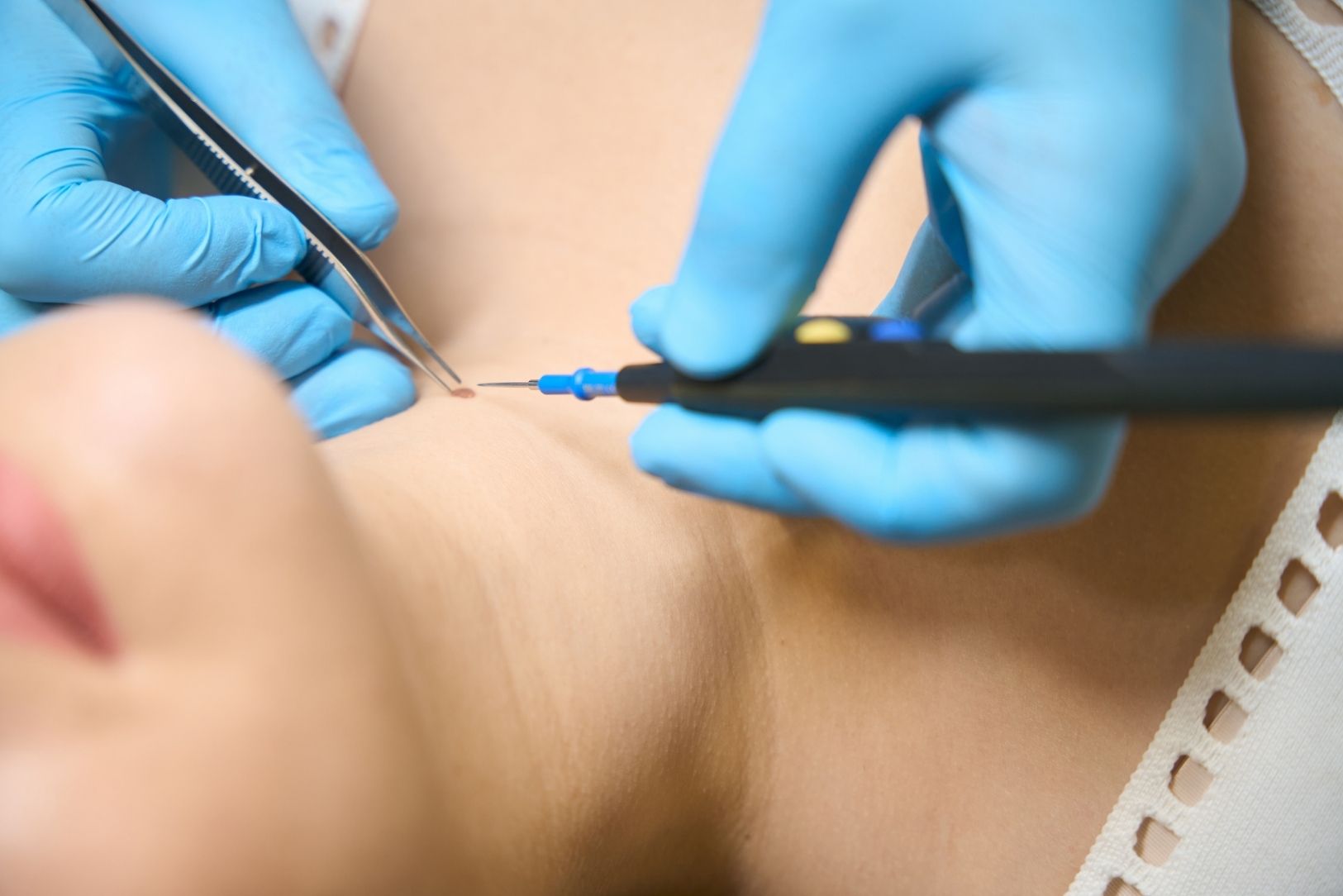
Electrocauterization is the procedure of burning skin lesions such as skin tags (nevi) and warts (verruca) using high-frequency electric current. This method allows the lesion to be removed in a controlled manner and causes minimal damage to the surrounding tissues. It is generally performed under local anesthesia and is completed in a short time.
In skin tag treatment, electrocautery precisely removes benign formations on the skin surface. After the procedure, the area is sterilized and a small scab forms. The scab falls off on its own within 7–10 days, revealing healthy skin tissue underneath. The risk of scarring is generally low.
In wart treatment, electrocauterization effectively removes lesions caused by the HPV virus. It may be preferred as an alternative to laser or cryotherapy. Results can be achieved in a single session, but several sessions may be required for widespread warts. After the procedure, the area should be kept clean and dry.
During the recovery process after electrocauterization, the scab should not be picked off and direct sun exposure should be avoided. The antiseptic creams recommended by the doctor should be used, and care should be taken against the risk of infection. When applied correctly, this method provides effective results both aesthetically and medically.
| Things You Should Know | Information |
| What are skin tags and warts? | Skin tags are generally harmless, soft, small skin outgrowths. Warts, on the other hand, are raised, firm lesions on the skin caused by the HPV virus. |
| What is the burning procedure? | In the method called electrocauterization, heat is generated with high-frequency electric current, and this heat is used to burn the skin tag or wart in a controlled manner and remove it from the tissue. |
| In which cases is it applied? | The procedure is preferred if there are complaints such as aesthetic discomfort, irritation due to friction with clothes or jewelry, itching or bleeding, or if the wart tends to spread. |
| How is the procedure performed? | The procedure is applied to the area made painless with local anesthesia. The lesion is eliminated starting from its base through the burning procedure. It usually takes a few minutes. |
| Post-procedure care | A sterile dressing is applied over the small wound that forms after the procedure. Scab formation is normal, and the scab falls off on its own within 1–2 weeks. The area should be kept clean and should not be picked. |
| Recovery process | Generally, the scab falls off within 7–10 days and new skin forms. Depending on the skin type and the depth of the lesion, a slight scar may remain. |
| Advantages | It is applied quickly and generally gives results in a single session. The risk of bleeding is low. In small and superficial lesions, the possibility of scarring is low. The return to daily life is fast. |
| Things to pay attention to | It may recur in deep or widespread warts. If post-procedure care is neglected, the risk of infection and scarring may increase. If the type of lesion is not clear, doctor evaluation before the procedure is important. |

Specialist Dr. Seval Karasatı
Dr. Seval Karasatı is a dermatology (skin diseases) specialist in Ankara specializing in skin health, hair and nail diseases, aesthetic dermatology, and laser applications. With her scientifically based approach and aesthetic perspective, she offers personalized treatment plans for each of her patients.
In the field of dermatology, Dr. Seval Karasatı specializes not only in common skin problems such as acne, rosacea, eczema, allergic skin diseases, and hair loss, but also in mole monitoring and the early diagnosis of skin cancers. She provides effective solutions to her patients with modern devices and up-to-date treatment methods.
Serving as a dermatology specialist in Ankara, Dr. Seval Karasatı is also experienced in aesthetic dermatology procedures. She applies holistic treatments aimed at skin renewal and rejuvenation with procedures such as fillers, PRP, mesotherapy, gold needle, and laser treatments.
Dr. Seval Karasatı conducts a comprehensive evaluation for each patient and shapes the treatment process according to personal needs. Her goal is not only to treat diseases but also to help achieve a healthy, vibrant, and aesthetically balanced skin appearance.
Create an Appointment
What Is Electrocauterization?
Electrocauterization is a surgical method in which tissue cutting, burning, or bleeding control is performed using heat-generating electric current. It is frequently used in the treatment of skin lesions, warts, moles, and some superficial tumors. It is also preferred for controlling bleeding during surgical procedures. It is applied with local anesthesia and generally heals without leaving a scar.
What is a skin tag (acrochordon) and why does it occur?
Skin tags are small, soft, pedunculated protrusions extending outward from the skin, usually flesh-colored or light brown. Their medical name is “acrochordon” or “fibroepithelial polyp.” Although they are generally 1–5 mm in size, they may sometimes be larger.
In fact, these are completely benign normal tissue growths and have nothing to do with cancer. They do not pose a health danger. However, the places where they are most commonly found are areas where friction is high. They appear in places such as the neck, armpits, eyelids, and groin area. Therefore, they may become irritated, bleed, or cause pain by rubbing against clothing, necklaces, or during shaving. For many patients, they may also be cosmetically disturbing.
Although the exact cause is unknown, some risk factors thought to trigger the formation of skin tags are:
- Excess weight (Obesity)
- Insulin resistance or Type 2 Diabetes
- Genetic predisposition (frequent occurrence in the family)
- Pregnancy (due to hormonal changes)
- Aging
Interestingly, the presence of skin tags, especially if they are numerous, may sometimes be a sign of metabolic syndrome or insulin resistance in the body. Therefore, they are sometimes evaluated not only as a skin problem but also as an indicator of general health.
What is a wart (verruca) and why does it occur?
A wart is a completely different structure from a skin tag. A wart is an infection caused by a virus called Human Papilloma Virus (HPV), which settles in the upper layer of the skin. After the virus enters the skin, it causes the cells there to multiply uncontrollably and forms raised, rough, “cauliflower-like” structures protruding from the skin.
They can be seen on the hands, fingers, soles of the feet, or anywhere on the body. Those that appear on the sole of the foot (plantar warts) may grow inward under the pressure of body weight and cause severe pain while walking.
The most important feature of warts, unlike skin tags, is that they are a viral infection. This is the main reason why they are both contagious and stubborn.
What are the main differences between skin tags and warts?
We see that our patients often confuse these two structures. However, there are very clear and sharp differences between them that completely change the treatment approach:
The most basic differences between them are:
- Cause: A skin tag is a tissue growth, whereas a wart is a virus (HPV) infection.
- Contagiousness: Skin tags are absolutely not contagious. Warts, on the other hand, are highly contagious.
- Spread: Skin tags do not spread (although new ones may appear). Warts, however, can spread both to other parts of the body (for example from the hand to the face) and to other people (shared towels, pools, gym floors).
- Appearance: Skin tags are generally soft and pedunculated. Warts, on the other hand, are firm, rough, and cauliflower-like in appearance.
Because of these differences, wart treatment is not only a cosmetic procedure but also a necessary medical intervention to stop a contagious infection.
Why is it absolutely necessary to see a dermatologist before having a lesion removed?
This is perhaps the most important and vital step of the whole process. Today, various “skin tag / wart burning” solutions or patches are sold on the internet or in pharmacies. However, applying a “blind” treatment without being sure what a lesion is carries very serious risks.
The most important reason for this is correct diagnosis. A dermatologist not only looks at the lesion but also examines the deep structure of the lesion with a special illuminated magnifier called a “dermatoscope.” This examination is critically important for the following:
- Distinction: To understand whether the lesion is a skin tag, a wart, or simply a “mole” (nevus).
- Cancer Risk: Most importantly, sometimes a lesion that looks like an innocent skin tag or wart may actually be a skin cancer (for example basal cell carcinoma or malignant melanoma).
If a cancerous tissue is destroyed by a method such as freezing or burning without understanding what it is, the chance for pathological examination (biopsy) is lost forever. Since the tissue is destroyed, no diagnosis can be made, and this can lead to a delay that may endanger the patient’s life. Therefore, no matter how simple it looks, every lesion must be evaluated by a dermatologist.
What is cryotherapy (freezing treatment) and how is it applied?
Cryotherapy is one of the fast, effective, and practical methods we use most frequently in dermatology. Basically, it is performed using liquid nitrogen gas at -196°C.
In this method, we apply liquid nitrogen directly onto the lesion with a special spray device or a cotton swab. The aim is to freeze the targeted tissue (skin tag or wart) within seconds. Think of it this way: we freeze the tissue so quickly that the water inside the cells suddenly turns into ice crystals. These ice crystals break the cell membrane and cause the controlled death of the cell (“necrosis”). At the same time, the fine capillaries feeding the lesion also freeze and become blocked, so the lesion dies because it can no longer be nourished.
In skin tags, this procedure is much simpler. Since skin tags are not viral and are superficial, a short freezing procedure of generally 5–10 seconds is enough. Most of the time, a single session is sufficient. After the procedure, the skin tag darkens, dries, and falls off on its own within 1–2 weeks.
Why is freezing treatment more difficult for warts?
When we apply the same method (cryotherapy) to warts, things become a little more complicated. This is because warts are stubborn structures containing the virus and settle deeper into the skin.
In wart treatment, our goal is to reach the deepest cells where the virus is located.
- Preparation (Paring): Especially on thick-skinned warts such as those on the sole of the foot, there is a thick, callus-like dead layer that we call “hyperkeratosis.” This layer is like a shield that prevents the cold from penetrating deeply. Therefore, before the procedure, this dead layer must be shaved off (paring) with a scalpel.
- More Aggressive Freezing: In warts, compared to skin tags, a longer (10–20 seconds) and deeper freezing procedure is performed. Sometimes, a double cycle is even applied in the form of “freeze-thaw-freeze again.”
- Need for Sessions: Warts almost never disappear in a single session. Depending on the resistance of the virus and the depth of the wart, 2 to 6 sessions may be required at intervals of 2–4 weeks.
Contact Us for Anything You Wonder About Skin Health!
What is electrosurgery (burning treatment) and how does it work?
Electrosurgery is the method commonly known as “burning” or “cauterization” among the public. However, in this procedure, we do not touch the skin with a fire or a heated wire. The devices we use (such as a “hyfrecator”) generate high-frequency electric current.
This current is transmitted to the tissue through a pen-like tip. The current targets the water inside the cells in the tissue. You can think of it this way: the current suddenly boils and vaporizes the water inside the cell in less than one-thousandth of a second. The cell cannot withstand this pressure and “explodes.” This provides immediate coagulation and drying (desiccation) of the tissue.
The procedure is performed under local anesthesia (by numbing the area), so it is not painful. Especially in wart treatment, it is very effective in destroying virus-infected tissue by vaporizing it.
What are the advantages of burning treatment compared to freezing treatment?
Both methods have their place, but especially in the case of stubborn and recurring warts, some clear advantages of electrosurgery stand out.
- Single-Session Success: In stubborn warts, while freezing treatment (cryotherapy) requires multiple sessions, it is generally possible to achieve very high success rates (up to 90%) with electrosurgery (burning) in a single session. This makes it a strong option in treatment-resistant cases.
- Dry Wound Healing: This is perhaps one of the most important differences. After cryotherapy, a blister or a wet wound generally forms in the area. This wet environment is more open to secondary bacterial infections. Electrosurgery, on the other hand, leaves behind a dry, charred wound. This dry scab acts as a kind of “natural bandage,” significantly reducing the risk of infection and making care easier.
- Bleeding Control: The electrosurgical current coagulates (seals) small capillaries at the same time while destroying the tissue. Thus, it provides a bloodless procedure.
How is laser treatment for skin tags and warts performed?
Laser technology gives us the opportunity to work very precisely and in a targeted way in dermatology. When we say “laser burning,” two different types of laser actually stand out:
- Carbon Dioxide (CO2) Laser:
This is an “ablative,” that is, tissue-destroying laser. The CO2 laser beam is absorbed very strongly by water. Our skin tissue is also 70–80% water. When the laser beam comes into contact with the skin, it instantly heats the tissue and vaporizes it (vaporization). In this way, we can destroy the skin tag or wart layer by layer with almost sculptor-like precision. It is a bloodless method and is especially effective in lesions in regions difficult to remove surgically or in numerous lesions.
- Pulsed-Dye Laser (PDL):
This laser works with a completely different logic. PDL is not an ablative (destructive) laser but a “vascular” laser. We mentioned that the black dots caused by warts are actually small capillary clots feeding the wart. Warts depend on these blood vessels to survive and grow.
Without damaging the skin, PDL directly targets the hemoglobin inside these blood vessels. It selectively heats, coagulates, and closes the vessels. Think of it this way: we are cutting off the wart’s “lifeline” or “supply line.” The wart that can no longer be nourished (ischemic) dies over time and is eliminated by the body. Since this method does not create an open wound on the upper surface of the skin, it is a great option especially in children and in cosmetic regions such as the face.
When are surgical methods (cutting) preferred?
Sometimes the simplest and most effective solution is to remove the lesion mechanically. This is an ideal method especially for pedunculated skin tags.
We call this “snip excision.” After numbing the area, the lesion is held with a sterile forceps (tweezers) and removed by cutting it from its base with special surgical scissors. The procedure takes seconds, gives immediate results, and heals very quickly.
“Shave excision” is used in broader-based, raised lesions (some skin tags or warts). Just as a razor shaves the surface of the skin, the lesion is cut horizontally at skin level with a special flexible blade.
The greatest advantage of surgical methods is that the removed piece can be sent to pathology (biopsy). If we have the slightest doubt about the nature of the lesion (such as suspicion of cancer), we always prefer to remove it surgically and send it for examination instead of destroying the tissue (burning/freezing).
Contact Us for Anything You Wonder About Skin Health!
How should post-procedure wound care be?
Post-procedure wound care is at least as important as the procedure itself and directly affects the quality of healing. Although there are small differences according to the procedure performed (burning, freezing, cutting), the general rules are very clear.
After procedures that create an open wound (burning, freezing, laser), the most critical rule is the “48-hour rule.”
- First 48 Hours: KEEP DRY: The treated area must absolutely not come into contact with water for the first 48 hours, that is, it must remain dry. Wetting the area seriously increases the risk of bacterial infection.
- After 48 Hours: KEEP MOIST: Contrary to the common belief that “let the wound stay open, get air, and dry out,” modern wound care advocates the exact opposite. After the 48-hour infection risk has passed, the wound must be kept moist. A moist environment allows cells to move faster over the wound, reduces scabbing, and provides much better cosmetic healing (less scarring).
The main steps to be followed during the healing process are:
- Keep the area dry and clean for the first 48 hours.
- After 48 hours, gently wash the area with soap and water (without rubbing) and dry it.
- Apply the antibiotic or reparative ointment recommended by your doctor onto the wound.
- Keep the area covered with a non-stick bandage.
- Repeat this procedure 1 or 2 times a day until the wound is completely closed.
- Protect the treated area from the sun for at least several months (to prevent staining).
What risks and complications may occur after the procedure?
These are extremely safe procedures that we perform most frequently in dermatological practice. However, as with every medical intervention, some rare risks do exist.
The most common ones are bleeding, infection, discoloration, or scarring. Especially, attention should be paid to the signs of infection.
If you notice any of the following signs, you must definitely consult your doctor.
- Pain in the area that increases instead of decreasing
- Redness spreading outward from the wound edge
- Excessive swelling and increased warmth in the area
- Purulent (yellow-green) or foul-smelling discharge from the wound
- High fever or chills
Will there be a scar after the treatment?
This is what our patients are most curious about. Any intervention that reaches the lower layer of the skin that we call the “dermis” (incision, burn, freezing) is repaired by the body with a “scar,” that is, scar tissue. This is a biological fact.
For this reason, the promise of “scarless treatment” is not medically accurate. Our goal is to perform the procedure so controlled and precisely, and to provide such good wound care afterward, that the resulting scar remains minimal, barely noticeable, and aesthetically acceptable. Especially in superficial lesions such as skin tags and warts, the results are generally excellent. However, some people’s skin may be prone to forming “keloids” (excessive scar tissue growth) or “hypertrophic scars” (raised scars).
Do skin tags or warts recur after treatment?
The answer to this question is completely different for skin tags and warts.
Skin Tags: A treated skin tag (frozen, burned, or cut) does not recur from the same spot if its root has been completely removed. However, if the person’s body is prone to forming skin tags (genetics, insulin resistance, etc.), NEW skin tags may continue to appear immediately next to the same area or in other parts of the body over time. This does not mean that the treatment has failed.
Warts: In warts, the situation is the opposite. Since the cause of the wart is the virus (HPV), there is always a risk of recurrence (relapse). Even if we destroy the visible wart with treatment, sometimes hidden (subclinical) viral particles may remain in the surrounding normal-looking tissue. At a time when body resistance drops, this virus may become active again and the wart may recur from the same place. In this case, it may be necessary to switch to a different or more aggressive treatment method (for example from freezing to burning or laser).
How is it decided which treatment should be chosen?
There is no single answer to the questions “Which is the best treatment for warts?” or “What removes a skin tag best?” As dermatologists, we evaluate many factors at the same time when determining the correct treatment:
- Type of the Lesion: Is it a skin tag or a wart? (The most important criterion)
- Location of the Lesion: Whether it is on the face, eyelid, hand, or sole of the foot changes the whole approach. (For example: freezing is not done on the eyelid; snip excision is preferred).
Is there a single large lesion, or dozens of small lesions?
- History of Resistance: Has this wart not responded to another treatment before? (Is it a stubborn wart?)
- Patient’s Skin Type: Since the risk of staining (pigmentation) is higher in a dark-skinned patient, laser or freezing doses are adjusted accordingly.
- Patient Preference: Factors such as the healing process, cost, and number of sessions also affect the decision.
For this reason, deciding together on the most correct and most effective method for you after a simple examination is the healthiest way.
Frequently Asked Questions
How is the procedure for burning skin tags and warts performed?
The procedure for burning skin tags and warts is generally performed with cryotherapy, radiofrequency, or electrocautery methods. In these methods, freezing is performed with cold gas or the lesion is vaporized and removed from the tissue using high heat. The procedure is short and the risk of scarring is low.
Will there be a scar after burning skin tags and warts?
When the procedure is done professionally, there is generally no scarring. However, skin type, the depth of the lesion, and the care process affect the results. Protection from the sun and the use of moisturizer reduce the risk of scarring.
Does burning skin tags and warts cause pain?
Since the procedure is performed under local anesthesia, pain is generally not felt. There may only be a slight stinging or feeling of warmth. Afterwards, short-term redness and sensitivity may be seen.
How long does the recovery process take after burning skin tags and warts?
The recovery period is generally between 5 and 10 days. During this time, scabbing is normal and should not be picked off. With proper care, the skin returns to its former state in a short time.
Does the wart burning procedure prevent the virus from recurring?
Warts occur due to the HPV virus, and the burning procedure destroys the existing lesion, but it does not completely eliminate the virus. If the immune system is not strengthened, warts may recur.
Is the skin tag burning procedure safe on the face area?
Yes, when performed by experienced dermatologists, it is also safe on the face area. The procedure is performed with low energy by taking skin tone and lesion type into account, thus reducing the risk of scarring or discoloration.
Can the procedure for burning skin tags and warts be performed on pregnant women?
During pregnancy, aesthetic procedures are not recommended unless there is a serious medical necessity. However, for bothersome warts, safe methods may be preferred with the doctor’s approval.
What should be considered after skin tag burning?
After the procedure, the area should be kept clean, protected from the sun, and the scabs should not be picked off. Caring for the area with antiseptic cream or products recommended by the doctor reduces the risk of infection.
Can burning skin tags and warts be done with a laser?
Yes, laser technology can also be used for these procedures. The laser burning procedure works more precisely, does not damage the surrounding tissues, and is especially preferred in visible areas such as the face.
Is there a risk of recurrence after burning skin tags and warts?
Skin tags are generally removed permanently and do not recur. However, since warts are of viral origin, they may reappear if immunity is weak or contact continues.